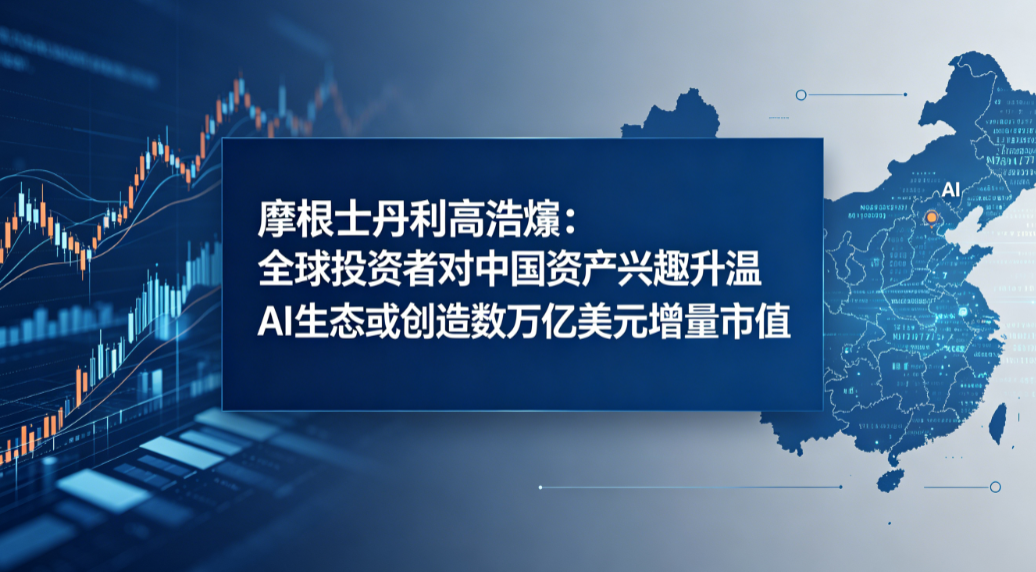
From AI to Capital Market Mechanisms: New Logic for Foreign Capital Revaluing Chinese Assets
Keywords: Lujiazui Forum, Morgan Stanley, Chinese Assets, Artificial Intelligence, Energy Transition, Capital Markets, Institutionalization, Index Weight, Shanghai International Financial Center
Introduction
During the 2026 Lujiazui Forum, a speech by Gokul Laroia, CEO of Morgan Stanley Asia and Global Co-Head of Equities, once again brought global capital's attention to China's market to the forefront. Compared to last year, this year's discussions by foreign institutions on China have moved beyond valuation repair, policy expectations, or short-term trading opportunities, shifting further toward more long-term global capital expenditure themes such as AI, energy transition, defense, and industrial infrastructure.
Behind this change is an update in the cognitive framework of international investors toward Chinese assets: China is not just a large emerging market, but an important participant in the global tech supply chain, industrial upgrade, and capital formation. What Laroia emphasized is not the prosperity of a single industry, but China's structural position in the global investment cycle for years to come.
1. AI Becomes Core Keyword, China's Supply Chain Value Revalued Again
The key word Laroia emphasized most in his speech was artificial intelligence. He pointed out that global AI investment has grown to about $1 trillion to $1.5 trillion annually, mainly occurring in the US, but investments in China and the rest of the world are also increasing rapidly. More crucially, the supply chain supporting this round of AI expansion is not concentrated only in the US, but is widely rooted in Asia, especially China, South Korea, and Japan.
This means the AI wave is not a pure "US tech narrative," but a systems project jointly supported by global manufacturing, computing, energy, and engineering capabilities. China's advantage lies not only in the manufacturing link but also in the collaborative capability of a complete industry chain. From semiconductor localization to data centers, cloud services, large language models, digital applications, and even physical scenarios like humanoid robots, China is forming an independent and relatively complete AI ecosystem.
Laroia believes that apart from the US, China is the only market with a comprehensive AI ecosystem. This judgment carries particular weight because it means AI investment opportunities in China are not limited to a few leading companies but cover a large number of upstream and downstream enterprises. When Morgan Stanley exchanged ideas with Chinese companies, they found that the number of companies participating in this ecosystem reaches hundreds, all of which need capital support and may release valuation space during technological iteration and commercialization.
2. $3-4 Trillion Market Cap Potential from Systemic Expansion of the Industry Chain
Laroia proposed that China's AI ecosystem has the potential to create $3-4 trillion in incremental market cap. This number attracted market attention not only because of its astonishing scale but also because it reveals an important logic: the opportunity in capital markets is no longer just about "buying undervalued assets," but about accommodating an expanding industrial ecosystem.
The value creation of the AI industry chain has obvious layer-by-layer transmission characteristics. Upstream requires computing power, chips, servers, and power systems; midstream requires data centers, cloud platforms, and engineering capabilities; downstream relies on model applications, software ecosystems, and terminal scenarios. Each link requires continuous investment, often with cash flow under pressure in early stages; only longer-term, more stable capital can support its growth.
Therefore, Laroia's judgment essentially hints to the market: what is truly worth attention is not whether a single company has short-term stock price elasticity, but whether the entire capital market can provide financing, liquidity, and exit mechanisms for innovative companies. In other words, whether industrial opportunities can translate into market cap space depends on the capital market's carrying capacity.
3. Beyond AI, Energy Transition and Defense Also Form Long-Term Capital Expenditure Main Lines
In addition to AI, Laroia also regards energy, energy transition, and defense as equally important global themes. He cited analysis that annual spending in these three areas will grow from about $11 trillion to $16 trillion. Such scale of growth means that industrial infrastructure, equipment manufacturing, and system integration companies will face broader market space.
This judgment is particularly important for the Chinese market. Chinese companies have strong global competitiveness in areas such as energy equipment, power systems, industrial manufacturing, and some security-related industries. In other words, China is not passively participating in these global trends but has supply capacity and industrial foundations in multiple key fields. The reason capital flows to China-related assets is essentially because Chinese companies can provide real production capacity, technology, and engineering solutions in these long-term main lines.
From an investment perspective, AI, energy transition, and defense are not short-term themes, but long cycles that will continue to absorb capital for years. This cyclicality determines that foreign institutions' reassessment of China is shifting from "macro trading" to "industrial allocation."
4. For Foreign Capital to Truly Enter China, Mechanism Building Is More Important Than Narrative
Laroia's speech did not stop at "being bullish on China," but further proposed three specific recommendations, showing the real demands of foreign capital for market mechanisms.
First, continue to promote market institutionalization. He pointed out that institutional investors account for about 40% of trading volume in the Chinese market, compared to 80-85% in the US market. A higher degree of institutionalization means more stable sources of funds, more professional pricing ability, and lower irrational volatility. For technological innovation and industrial upgrading, long-term capital is clearly more critical than short-term speculative funds.
Second, enrich the product variety in the Chinese market to increase global investor participation. He specifically mentioned cooperating with global index providers to raise China's weight in global indices and improve issues such as free-float market cap limits, trading mechanisms, holiday mismatches, and hedging tools. For foreign capital, what determines "whether they can invest" is not just a bullish judgment on China, but whether they have sufficiently convenient trading and risk management conditions.
Third, reduce friction in investing in the market and maintain regulatory transparency and consistency. He gave a positive assessment of the CSRC's comment solicitation mechanism, believing that transparent and sufficient rule discussions help enhance investor confidence. For global institutional investors, clear rules, stable mechanisms, and smooth communication often determine whether funds stay long-term more than short-term returns.
5. Active Management ETFs and IPO Cross-Border Connectivity Signal a New Phase of Market Opening
Laroia also specifically mentioned the importance of actively managed ETFs and the potential of IPO cross-border connectivity. These seemingly technical arrangements are actually important levers for the further internationalization of China's capital markets.
The significance of actively managed ETFs is that they can productize professional investment capabilities, both meeting the upgrading needs of residents' wealth management and providing more flexible allocation tools for institutional funds. IPO cross-border connectivity helps further integrate resources between Shanghai and Hong Kong markets, improving the efficiency of cross-border capital allocation and allowing more excellent companies to gain attention from global investors.
It can be said that these mechanism innovations are not just "incremental tools," but markers of China's capital market transitioning from scale expansion to quality improvement. The reason foreign institutions pay attention to these arrangements is that the more mature the market, the longer the capital duration, and the higher the probability of funds staying.
Conclusion
Gokul Laroia's speech at the Lujiazui Forum sent a clear signal: foreign capital's renewed attention to the Chinese market is no longer just about finding cheap assets, but about repositioning China within the global capital expenditure cycle for AI, energy transition, and industrial infrastructure.
China's attractiveness is shifting from the traditional growth story to more structural industrial capabilities and supply chain positions. But to translate this attractiveness into sustained long-term capital inflows, the market still needs to continue improving in areas such as institutionalization, product richness, index weight, hedging tools, and regulatory transparency.
For the construction of the Shanghai International Financial Center, this is both a challenge and an opportunity. In the future, what truly determines whether the revaluation of Chinese assets can continue is not just the interest of external capital, but whether the market itself can provide matching mechanisms, depth, and resilience. Only then can global capital's attention to China truly translate into long-term, stable, and sustainable investment forces.