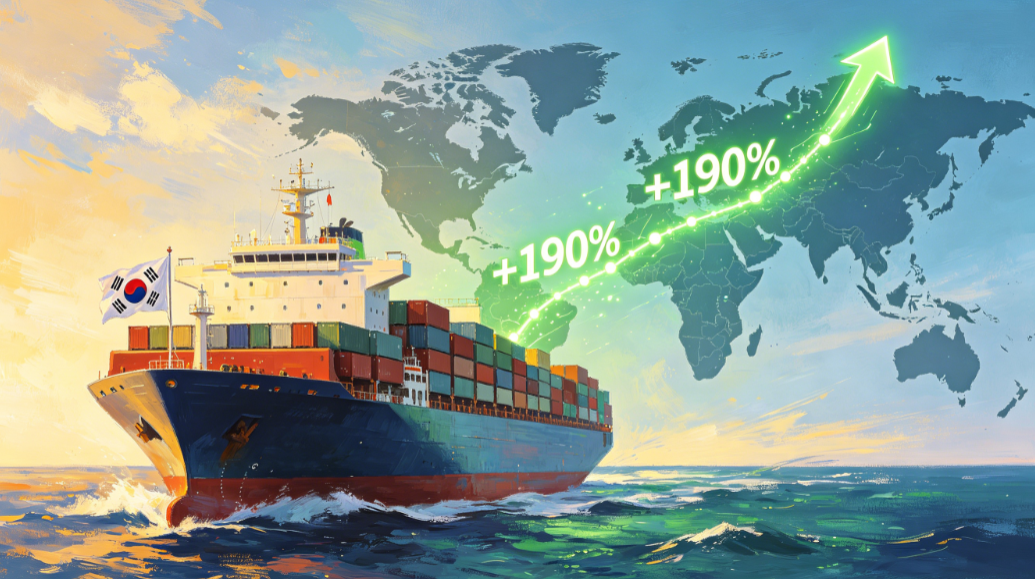
Korea exports hit record again: semiconductor engine drives trade growth, AI infrastructure demand continues to release
Keywords: Korea exports, semiconductors, AI infrastructure, trade surplus, SSD, global supply chain
Introduction
Korea's latest June 1-20 export data again sends a strong growth signal. According to statistics, Korea's June 1-20 exports reached $61.99 billion, up 60.4% YoY, not only a record for the period but also showing accelerating foreign trade momentum. Notably, this growth is not from traditional cyclical recovery but jointly driven by semiconductors, AI server-related equipment and global tech investment demand, highlighting Korea's unique position in the global AI infrastructure construction wave.
Semiconductors lead, becoming core pillar of export growth
Structurally, semiconductors remain the absolute main driver of Korea's export growth. For June 1-20, Korea's semiconductor exports surged to $25.5 billion, nearly 2.9 times the $8.8 billion in the same period last year, a record for the monthly 1-20 period. More importantly, semiconductor exports' share of total exports rose to 41.2%, up 18.3 percentage points from a year earlier, indicating further deepening of Korea's export reliance on the semiconductor industry.
Behind this change is sustained CapEx from rapid expansion of the global AI industry. Whether data center expansion or rising AI training and inference computing demand, demand for memory chips, HBM high-bandwidth memory, server SSDs and other products is increasing. Korean companies have long held leading positions in memory chips, making them one of the most direct beneficiaries of this AI infrastructure investment round. In other words, Korea's strong export performance is not just short-term cyclical recovery but an external manifestation of a new tech cycle dividend.
Related categories also strengthen, showing industry chain boom diffusion
Besides semiconductors, computer peripherals performed strongly, especially driven by AI server SSD demand, with export growth of 293.3%. This indicates AI's pulling effect on upstream hardware has extended from core chips to storage, servers and peripheral equipment, forming a more complete demand chain.
Meanwhile, passenger car exports grew 2.3% YoY, petroleum products grew 39.0%, showing Korea's traditional manufacturing and energy-related exports also maintain some resilience. Although these categories contribute less to overall growth than semiconductors, their stable performance helps enhance export structure balance and reduce sensitivity to a single industry's volatility.
Major export markets all recover, external demand support clear
By destination, Korea's exports to major markets increased almost across the board. Exports to China grew 86.9% YoY, to the US 53.9%, to Vietnam 75.5%, and to the EU 13.6%. This indicates Korea's export growth is not limited to one region but benefits from global supply chain recovery and increased tech procurement.
Notably, China, the US and Vietnam are key nodes in the global electronics supply chain. The sharp increase in Korea's exports to these markets means global tech manufacturing and end demand remain active, especially cross-border flows of AI servers, memory chips and related components are accelerating. For Korea, this broad external demand improvement helps enhance export sustainability, not just relying on short-term inventory restocking in a few markets.
Imports also rise, indicating active production and investment
Korea's June 1-20 total imports were $44.495 billion, up 23.2% YoY. Semiconductor imports grew 55.5%, crude oil 18.8%, semiconductor manufacturing equipment 51.9%, machinery 2.8%, natural gas 8.3%. The simultaneous presence of import and export growth typically indicates domestic production activity and CapEx remain active, with companies having strong confidence in future demand.
In particular, the rapid growth of semiconductor manufacturing equipment imports suggests Korea's chip industry is not just relying on existing capacity but continuing to push expansion and technology upgrades. This is crucial for long-term competitiveness. In the AI era, improvements in memory chips, advanced packaging and manufacturing capabilities have become key variables determining industry position.
Trade surplus expands, foreign trade momentum remains high
With exports surging, Korea's June 1-20 trade surplus reached $17.496 billion, showing a healthy trade account. In May, Korea's exports had already reached a single-month record of $87.75 billion, up 53.2% YoY; semiconductor exports alone reached $37.16 billion, up 169.4% YoY, accounting for over 40% of total export revenue. By May, Korea's exports had grown for 12 consecutive months, indicating strong continuity of this foreign trade expansion.
From a macro perspective, this round of growth reflects both the high boom of the global AI supply chain and Korea's comparative advantage in high-value-added manufacturing. Semiconductors not only drive exports but also boost demand for equipment, logistics, energy and related intermediate goods, forming multi-level linkage effects. For Korea's economy, this tech-driven growth model is becoming an important foundation for stabilizing external demand and supporting growth.
Conclusion
Overall, Korea's June 1-20 exports hitting a record high is no accident but the combined result of global AI infrastructure investment, semiconductor industry cycle recovery and Korea's own industrial competitiveness. Semiconductors as the core engine are driving Korea's export growth with unprecedented intensity; meanwhile, related equipment, storage products and major export market improvements indicate this round of growth has broad breadth and depth.
Looking ahead, if the global AI computing expansion trend continues, Korea's exports are expected to remain high. However, uncertainties such as changes in global tech investment pace, geopolitical risks and semiconductor cycle fluctuations also need attention. For Korea, how to maintain semiconductor advantages while further optimizing export structure and expanding new growth points will determine whether its foreign trade growth can move from "high boom" to "high resilience."