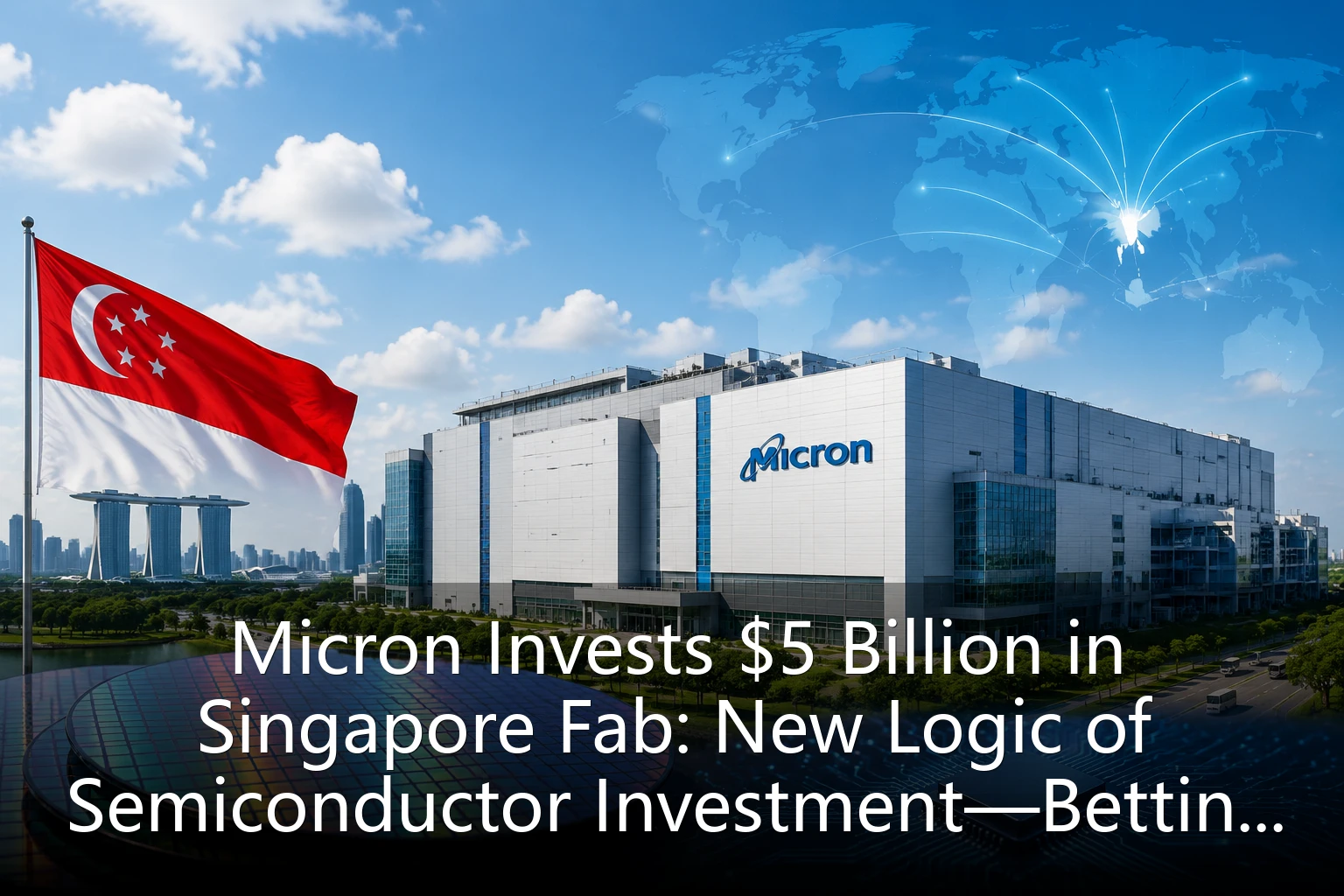
On July 28, 2026, Micron Technology officially announced a $5 billion investment to build a new advanced memory wafer fab in Singapore. This blockbuster news quickly shook the global semiconductor industry, seen as another landmark event in the migration of chip supply chains to Southeast Asia. Amid global geopolitical tensions and a surge in chip localization, what investment logic does Micron's "big bet" reflect? And what does it mean for investors focused on the chip sector?
1. Investment Details: Focusing on Advanced DRAM and HBM Capacity
According to Micron's official statement, the new fab will focus on producing next-generation DRAM chips and HBM (High Bandwidth Memory) products, with production planned to start in 2028. The Singapore fab will utilize Micron's most advanced manufacturing processes and introduce AI-driven automated production systems. Micron CEO Sanjay Mehrotra said, "Singapore has mature infrastructure, a high-quality talent pool, and strong government support for the semiconductor industry, making it an ideal location for expanding advanced memory production."
2. Why Singapore? — The "Gravitational Field" of Southeast Asia's Supply Chain
Micron is not the first semiconductor giant to invest heavily in Singapore. Previously, foundries such as TSMC, UMC, and Vanguard International Semiconductor have set up or expanded 12-inch wafer fabs in Singapore, while Infineon and STMicroelectronics have also deployed packaging and testing capacity here. As a semiconductor hub in Southeast Asia, Singapore's appeal is reflected in the following aspects:
- Policy Stability and Open Environment: The Singapore government provides tax incentives, land support, and R&D subsidies through the Economic Development Board (EDB), and actively promotes trade agreements with Europe, the U.S., and Japan to reduce operational risks for companies.
- Talent and Infrastructure: Singapore has a well-established STEM education system and abundant semiconductor engineer resources, along with stable power supply, efficient logistics, and other hard conditions.
- Geopolitical Neutrality: Against the backdrop of U.S.-China tech decoupling, Singapore, as a neutral country, can serve the Chinese market while meeting U.S. customer compliance requirements, becoming a "buffer zone" for the supply chain.
- Industrial Cluster Effect: Micron's new fab is adjacent to its existing NAND flash packaging and testing facilities, enabling vertical integration from wafer fabrication to packaging and testing, reducing coordination costs.
3. Investment Logic Restructured: From "Efficiency First" to "Security + Resilience"
Over the past decade, semiconductor investment has mainly followed the principle of "efficiency first," with capacity highly concentrated in regions such as Taiwan and South Korea. However, since 2020, chip shortages, COVID-19 disruptions, and geopolitical conflicts have exposed the fragility of the global semiconductor supply chain. Micron's investment decision reflects the new logic of current chip investment:
1. Supply Chain Diversification Becomes a Must
Whether in the U.S., Europe, or Japan, there is a push for chip manufacturing reshoring or "friend-shoring." Singapore, as a "friend-shore" country, can maintain technical collaboration with Western allies while radiating into Asian markets, becoming a key node for balancing geopolitical risks. Micron's move reduces dependence on a single region (e.g., Taiwan) and enhances supply resilience.
2. Dual Drivers of Policy Subsidies and Market Incentives
Although Micron has not disclosed the details of government subsidies for this investment, referencing GlobalFoundries' previous $4 billion expansion project in Singapore, which received approximately $600 million in subsidies, it is expected that Micron will receive similar support. At the same time, Singapore is launching its "Singapore Chip Plan," using national research funds to jointly tackle frontier areas such as advanced packaging and edge AI chips with private enterprises.
3. Historical Gains from Bottom-of-Cycle Memory Layout
The memory industry is highly cyclical. Historically, counter-cyclical capacity expansion during downturns has often yielded rich returns. Currently, DRAM prices have rebounded about 30% from their 2025 lows, and HBM capacity remains tight. Micron's expansion at this time precisely positions it for the upcycle. Institutions forecast that the HBM market will exceed $40 billion by 2027, and Micron is expected to capture a larger share with its new fab.
4. Impact on Singapore and Southeast Asia's Semiconductor Ecosystem
Micron's new fab is expected to create approximately 3,000 direct jobs in Singapore and drive the clustering of upstream equipment, materials, design services, and other supporting industries. More importantly, it will enhance Singapore's global position in memory manufacturing—currently Singapore is already a key base for Micron's NAND flash production, and the addition of DRAM capacity will make it Micron's third DRAM manufacturing center globally (the other two are in the U.S. and Japan).
For the entire Southeast Asian semiconductor supply chain, Micron's investment will accelerate the extension of regional manufacturing capabilities from packaging and testing to upstream wafer fabrication. Countries like Malaysia and Vietnam are also actively attracting chip design, packaging, and testing segments, but Singapore, with its high-end manufacturing advantages and intellectual property protection environment, remains the preferred location for advanced process implementation.
5. Investor Perspective: Which Areas Are Worth Watching?
Micron's Singapore investment offers several key takeaways for chip investment:
- Focus on Southeast Asian Semiconductor Equipment and Materials Stocks: As more wafer fabs are built, local suppliers of equipment maintenance, gas chemicals, substrates, etc., will benefit. For example, Singapore's UMS Holdings (semiconductor equipment OEM) and France's Air Liquide (with gas plants in Southeast Asia).
- Cyclical Allocation Opportunities in Memory ETFs or Individual Stocks: In the early stages of memory recovery, consider diversifying through ETFs like the iShares PHLX Semiconductor Index, or directly focus on leading companies such as Micron, Samsung, and SK Hynix.
- Policy-Driven Thematic Investments: Sub-sectors supported by the Singapore government, such as advanced packaging, edge AI chips, and the RISC-V ecosystem, may see growth targets emerge.
- Risk Warning: Semiconductor capacity expansion typically takes 2-3 years to come online, during which there is a risk of weaker-than-expected demand. Additionally, geopolitical changes (e.g., further tightening of U.S. export controls to China) could affect the stability of the Southeast Asian supply chain.
6. Conclusion
Micron's $5 billion investment in Singapore is far more than a single company's capacity expansion. It marks a shift in the global semiconductor industry from the "efficiency-first" paradigm of the past decades to a new paradigm that equally values security and resilience. For investors, understanding this logic is key to finding truly long-term anchors in the ebb and flow of the chip industry—whether it's a hub node like Singapore or the tech giants bold enough to increase bets at the cycle bottom.
With the continuous explosion of demand from AI, IoT, automotive intelligence, and more, the golden age of chip investment is far from over, but the map has been redrawn. The winners of the next decade may well emerge from this wave of supply chain restructuring.