SK Hynix Samples HBM4E: High-Bandwidth Memory Race Enters New Phase
Keywords: SK Hynix, HBM4E, High-Bandwidth Memory, AI Chips, Nvidia, Semiconductor Competition
Introduction
As generative artificial intelligence continues to expand, computing power demand is rising at an unprecedented rate. Behind the continuous breakthroughs in AI chip performance, the overall system efficiency is determined not only by GPU computing power itself, but also by key factors such as memory bandwidth, energy efficiency, and packaging technology. Among these, High-Bandwidth Memory (HBM) has become one of the most critical semiconductors in the AI era.
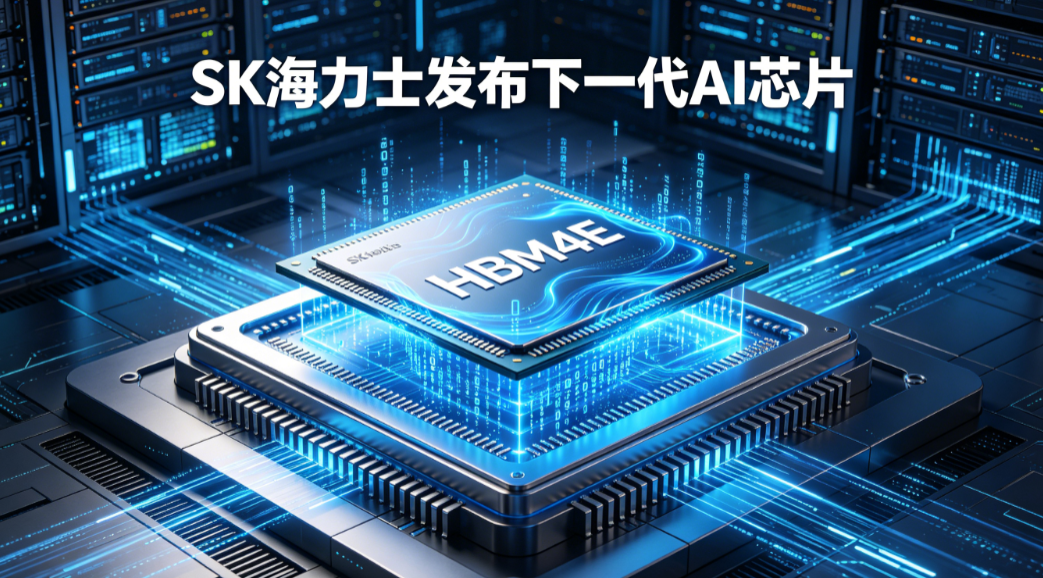
Recently, SK Hynix announced that it has sent samples of its next-generation HBM chips to major clients. This news not only indicates that its product development has entered a new verification stage, but also reflects the intensifying competition in the global AI semiconductor industry chain. As a key HBM supplier to Nvidia, SK Hynix's leading position in the high-end memory market is being redefined, while competitors such as Samsung and Micron are accelerating their catch-up. Around the technical upgrade and commercialization of HBM4E, a competition over performance, supply capability, and ecosystem cooperation is unfolding.
1. Why HBM Is a Core Component of AI Chips
HBM, or High-Bandwidth Memory, is an advanced memory solution designed for high-performance computing and AI applications. Compared to traditional DRAM, HBM uses a stacked structure and wider data channels to significantly improve data transfer efficiency and reduce energy consumption per unit bandwidth.
During AI training and inference, chips need to frequently process massive parameters and activation data. For large model training, computing power is not the only bottleneck; the speed of data transfer between the processor and memory often directly determines training efficiency and system cost. HBM's value lies here: it allows GPUs and other processors to access data faster, thereby improving overall throughput, reducing latency, and enhancing energy efficiency.
As a result, HBM has evolved from a "supporting component" to a key part of AI chip architecture. For AI chip makers like Nvidia, whether HBM supply is stable and performance is leading affects their product iteration and market competitiveness.
2. SK Hynix Advances HBM4E Sampling, Signaling Technical Upgrade
According to SK Hynix, the sampled chip is a next-generation 12-layer HBM4E. Its single-pin data transfer rate reaches up to 16 Gbps, with over 20% improvement in energy efficiency compared to the previous generation. This means that under the same power conditions, the new product can provide higher data transfer efficiency, better meeting the demands of AI servers for both high performance and low energy consumption.
"Sampling" does not equal mass production, but it is a critical step toward commercialization. Typically, after sample delivery, clients conduct compatibility tests, stability verification, power consumption evaluation, and packaging matching tests. Only after passing a series of rigorous certifications can the chip move to mass production and volume shipment. For products like HBM that rely heavily on client collaboration, sampling reflects not only technical maturity but also the closeness of supply chain cooperation.
From a product perspective, 12-layer stacking is an important path for HBM to continuously increase capacity and bandwidth. More layers mean stronger storage capacity per chip, but manufacturing difficulty, thermal management, and yield control also rise. SK Hynix's HBM4E sample indicates progress in stacking technology, signal integrity, and energy efficiency optimization.
3. AI Chip Industry Competition Shifts from "Computing Power" to "System Capability"
In the past, the market focused more on GPU computing scale and process advancement. Now, as AI model sizes expand, the determinants of system-level performance are changing. GPU, HBM, advanced packaging, interconnect technology, and software ecosystem together form the complete competitive landscape.
In this system, HBM's importance is particularly prominent. On one hand, AI chips need sufficiently high memory bandwidth to support large model operation; on the other hand, power control is increasingly critical. Data center clients not only care about "running fast," but also "running stable, running long, and cost-controllable." Therefore, HBM manufacturers' competition is no longer just about capacity and speed, but about balancing bandwidth, power, thermal design, yield, and supply capability.
The reason SK Hynix can maintain a leading position is largely due to its early bet on HBM and deep cooperation with top AI chip clients. Nvidia, as a bellwether in the global AI chip market, influences HBM suppliers' R&D directions through its product roadmap, supply pace, and technical requirements. For SK Hynix, continuously being in Nvidia's supply chain not only means stable revenue but also recognition of its technology roadmap by the industry's highest standards.
4. Samsung and Micron Accelerate Catch-Up, Industry Structure May Further Fragment
Although SK Hynix holds a leading position in the HBM market, competition has not weakened. Samsung and Micron are both investing in HBM R&D, trying to narrow the gap with next-generation products. For these two traditional memory giants, HBM is a significant opportunity to regain a voice in the high-end market.
Samsung has strong manufacturing capabilities and a complete semiconductor industry chain layout, with solid foundations in advanced packaging and logic chips; Micron has advantages in memory processes and global client resources. As AI demand grows, the HBM market is expanding rapidly, offering catch-up opportunities for latecomers. However, HBM barriers are high. Besides the chip itself, it involves adaptation with GPU, packaging substrate, cooling system, and client platform; any issue can affect the final verification result.
Therefore, future HBM competition is likely not "who can make it," but "who can pass client certification faster and deliver stable volume." In this sense, first-mover advantages, client collaboration, and mass production capability will continue to be key variables determining market share.
5. HBM4E Commercialization Prospects and Industry Impact
From an industry trend perspective, HBM4E represents the continued evolution of AI memory technology toward high bandwidth, high energy efficiency, and high integration. As large model parameter scales grow, data centers' requirements for single-chip throughput will only increase. In the future, whoever can first provide HBM products with high bandwidth, low power, and high reliability will likely occupy a core position in the AI hardware ecosystem.
For SK Hynix, this sampling is not just a product upgrade but a market signal. It means the company is preparing for the next round of AI hardware expansion and may further consolidate its position in Nvidia's supply chain. If subsequent verification goes smoothly and enters mass production, SK Hynix could continue to expand its lead in the high-end memory market.
From a macro perspective, the HBM competition upgrade also reflects the AI industry entering deep waters: as models grow larger and training becomes more complex, what truly determines industry structure is not just single-point computing breakthroughs, but the collaborative efficiency of the entire semiconductor ecosystem. HBM is a microcosm of this change.
Conclusion
SK Hynix sampling the next-generation HBM4E to key clients marks a new phase in AI memory technology competition. Higher transfer rates, better energy efficiency, and close cooperation with top clients keep it leading in the global HBM market. Meanwhile, competitors like Samsung and Micron are actively positioning, and future market structure remains variable.
It is foreseeable that as AI continues to reshape the semiconductor industry, HBM's importance will only grow. Whoever can simultaneously advance in technology iteration, client certification, and volume delivery will gain the initiative in the next wave of AI hardware. For SK Hynix, HBM4E sampling is just a new starting point; the real test lies in subsequent commercialization and scaled competition.