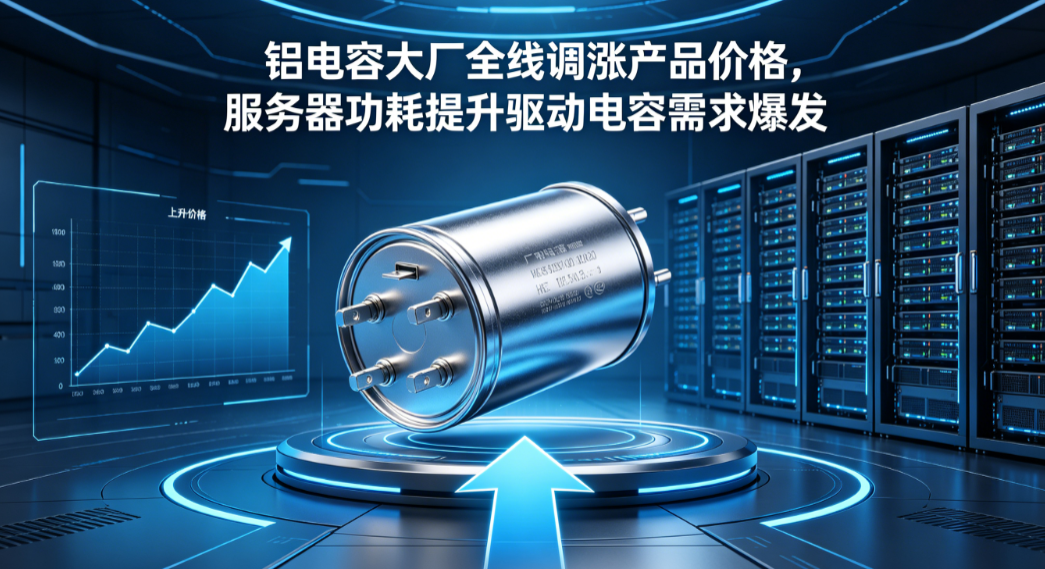
AI Computing Power Drives Capacitor Demand Upgrade, Nichicon Price Hike Sends New Signal in Supply Chain
Keywords: Aluminum Electrolytic Capacitors, Film Capacitors, AI Servers, Computing Infrastructure, Supply-Demand Tension, Faraday Electronics, Jiadeli
Introduction
Recently, Japanese aluminum capacitor giant Nichicon announced an across-the-board price increase for aluminum electrolytic capacitors, drawing widespread market attention. This price hike is not a simple business strategy adjustment, but the result of combined factors: upstream raw material costs, geopolitical risks, and downstream demand expansion. Especially against the backdrop of rapid AI computing evolution, server power consumption continues to rise, and data centers' demand for high-reliability, high-voltage, long-life capacitors has increased significantly, ushering in a new cycle of prosperity in the capacitor industry.
From an industry chain perspective, capacitors are not easily replaceable basic components. Whether in power management, filtering and voltage regulation, or high-frequency pulse response, capacitors play an important role in ensuring stable system operation. As GPU computing platforms upgrade and rack power consumption doubles, the quantity, specifications, and added value of capacitors are simultaneously increasing, presenting dual opportunities of demand expansion and product structure upgrades for related companies.
1. Behind Nichicon's Price Hike: Supply-Demand Imbalance and Cost Pressure Coexist
Nichicon's price increase for aluminum electrolytic capacitors can be attributed to two core reasons. First, order volumes for some products have exceeded current production capacity, indicating that market demand growth is faster than supply expansion. For manufacturing, supply shortages often first transmit to the price side, especially for electronic components requiring high stability and reliability, where customers have higher requirements for delivery cycles and product consistency, and short-term substitution is difficult.
Second, the continued turmoil in the Middle East has increased the difficulty of sourcing core raw materials for aluminum electrolytic capacitors. The capacitor industry relies heavily on upstream resources such as metal materials and electrolyte. Once the global supply chain is disrupted, companies typically face rising procurement costs and increased logistics uncertainty. Nichicon explicitly stated it cannot fully absorb cost increases, essentially reflecting that raw materials and manufacturing are under joint pressure.
This round of price hikes sends a clear signal: the pricing system in the capacitor industry is shifting from "cost-driven" to a parallel "demand-driven + cost-driven" model. For downstream customers, price increases mean not only higher procurement expenses but also that high-performance components are entering a more scarce resource phase.
2. Computing Power Iteration Accelerates, Capacitor Demand Enters Explosion Period
According to Zhao Yuyang of Northeast Securities, the acceleration of server generation replacement and the significant increase in single-rack power consumption form the underlying support for the explosion in capacitor demand. This judgment has a strong industrial reality basis. Taking Nvidia's server platform as an example, the H100 rack power consumption is about 50kW, while the GB300 NVL72 rack power consumption rises to 200kW, a 3.5-fold increase over the previous generation; the Rubin platform to be delivered will exceed 300kW per rack, meaning computing centers are entering the era of high power density.
The essence of increased rack power consumption is that more GPUs, more complex power supply systems, and higher-frequency data processing tasks are carried per unit space. To ensure voltage stability, reduce ripple interference, and improve system safety, server power modules, motherboards, GPU peripherals, and power supply paths all require more and higher-spec capacitors. Especially in high-voltage, high-current, and high-temperature environments, capacitors must be not only "usable" but also "durable" and "stable," directly pushing up product value.
From an industry trend perspective, the construction of AI computing infrastructure is not a short-cycle fluctuation, but a long-term process driven by model training, inference deployment, and cloud expansion. As large models iterate, edge computing lands, and data centers expand, capacitor demand is no longer limited to traditional consumer electronics but is gradually shifting to high-end industrial and computing infrastructure. This means the industry demand structure is undergoing profound changes, and the strategic position of high-end capacitor products has significantly improved.
3. Capacitor Product Value Increases, Industry Chain Companies See Opportunities
In the process of computing infrastructure upgrade, the growth of capacitors is not just an increase in quantity, but also a product structure upgrade. High-power servers impose higher requirements on components like film capacitors and aluminum electrolytic capacitors. Companies with advantages in materials, processes, and customer certification will more easily occupy favorable positions in the supply chain.
According to the Caixin theme library, among listed companies, Jiadeli is mainly engaged in R&D, production, and sales of BOPP electrical films. BOPP electrical films are mainly divided into two categories: polypropylene films for film capacitors and composite copper foil base films, among which capacitor films for film capacitors are key materials for film capacitors. With the expansion of data centers, new energy, and high-end power supply markets, demand for capacitor films is expected to grow synchronously. For such upstream material companies, industry prosperity not only brings order expansion but also helps improve product pricing power.
Faraday Electronics is mainly engaged in full-series film capacitors and metallized films, widely used in new energy, data centers, smart grids, rail transit, industrial control, and other fields. Its business layout is highly consistent with current high-power, high-reliability application scenarios. Especially in the data center field, film capacitors have advantages such as high voltage resistance, long life, and strong stability, with strong adaptability in power management and high-frequency filtering. As AI servers are deployed on a large scale, leading companies like Faraday Electronics are expected to continue benefiting from industry demand upgrades.
It is worth noting that competition in the capacitor industry is not only reflected in capacity expansion, but also in material formulas, process control, quality consistency, and customer certification cycles. Companies that can enter the supply chains of international top clients typically have stronger technical barriers and profitability resilience. Therefore, the current investment logic for the capacitor sector has shifted from traditional cyclical attributes to a growth logic of "high-end manufacturing + computing support."
4. Industry Trend Upward, But Structural Risks Need Attention
Although the capacitor industry is seeing rising prosperity, investment and industry judgments still need to remain rational. On one hand, AI server demand is growing rapidly, but the pace of downstream project implementation, capital expenditure cycles, and international supply chain changes may still bring phased fluctuations. On the other hand, if the capacitor industry undergoes large-scale capacity expansion, future price correction pressure after supply concentration must be watched.
In addition, raw material prices, exchange rate fluctuations, and overseas geopolitical factors will continue to affect company costs and profit levels. For industry chain companies, the true competitive advantage is not just the performance elasticity from short-term price increases, but whether they can establish long-term barriers in high-end products, global customers, and manufacturing efficiency.
Conclusion
Overall, Nichicon's across-the-board price increase for aluminum electrolytic capacitors is both a direct reflection of cost pressure and a microcosm of supply-demand tension in the capacitor industry. More importantly, this event resonates with the rapid upgrade of AI computing infrastructure, reflecting that capacitor demand is shifting from traditional electronics to high-growth scenarios like high-power servers and data centers.
As server generation replacement accelerates and single-rack power consumption continues to rise, both the quantity and product value of capacitors are expected to grow. Companies like Jiadeli and Faraday Electronics, with layout advantages in upstream materials and downstream devices respectively, may gain more growth space from this round of industrial upgrading. In the future, whoever can balance high reliability, high performance, and large-volume delivery will be more likely to seize the initiative in the new wave of computing.