The "Semiconductor Illusion" Behind S. Korea's ICT Export Surge: Structural Imbalance Needs Attention Beneath the Boom
Keywords: S. Korea ICT Export, Semiconductor, AI Servers, Trade Surplus, K-shaped Growth, Industrial Structure Imbalance
Introduction
According to Yonhap News, driven by the continued high boom in the global semiconductor industry, South Korea's ICT sector saw a rare export peak in May: both export scale and year-on-year growth hit new records. However, hidden behind the bright data are concerns. Multiple South Korean media and industry insiders warn that the current export growth is overly dependent on semiconductors and AI-related industries. If this single-driver pattern continues to expand, the Korean economy may fall into a so-called "semiconductor illusion" — concealing the fragility of the overall industrial structure under the cover of a few high-cyclical sectors.
Export Data Hits Record High, Semiconductor Becomes Absolute Mainstay
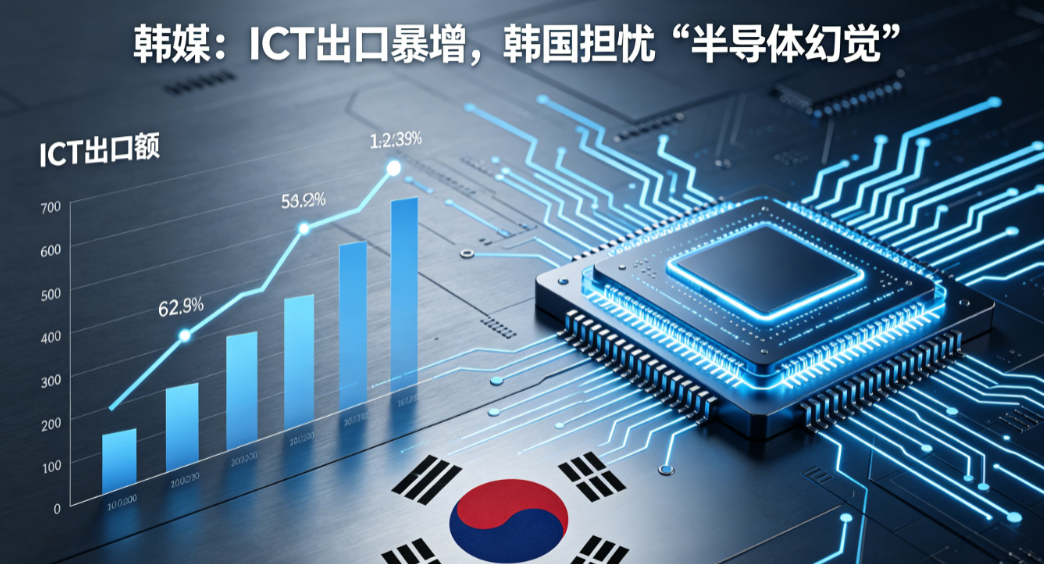
According to the "May 2026 ICT Import and Export Trends" released by the Ministry of Science and ICT and the Ministry of Trade, Industry and Energy on the 14th, South Korea's ICT exports in May reached $47.79 billion, up 128.9% year-on-year. This scale not only set a new record but also accounted for 54.5% of total exports, meaning the ICT sector has become the core pillar of Korea's foreign trade growth. More notably, ICT exports have exceeded the $40 billion mark for three consecutive months, indicating that this round of growth is not a short-term fluctuation but a sustained upward trend driven by industry recovery.
Structurally, this round of growth is almost entirely driven by semiconductors. The Korea Economic Daily pointed out that May semiconductor exports reached $37.16 billion, up 169.2% year-on-year, staying above $30 billion for three consecutive months and hitting a record export peak. Meanwhile, strong demand for AI server-related products further amplified semiconductor export performance. As Korea's "trump card" in manufacturing, semiconductors have shown strong external competitiveness again against the backdrop of global AI computing expansion, memory chip price recovery, and increased data center investment.
Trade Surplus Also Widens, Macro Expectations Improve
The strong export growth also directly pushed up Korea's ICT trade surplus. May ICT imports were $15.7 billion, up 36% year-on-year, while the trade surplus reached $32.09 billion, not only a new record but also the first time this figure exceeded $30 billion. This result shows that Korea's position in the global tech supply chain remains solid, and it maintains a clear advantage in high-end chips.
At the same time, the export boom has also improved market expectations for Korea's macro economy. The Bank of Korea and the OECD recently raised their growth forecasts for this year to 2.6%. In the short term, the semiconductor export recovery indeed helps drive investment, increase corporate profits, improve fiscal revenue, and boost market confidence. For the long-stressed Korean economy, this is undoubtedly a shot in the arm.
Behind the Boom, Risk of Industrial Imbalance Is Accumulating
But the problem is whether this growth represents an overall recovery of the Korean economy. The answer is not optimistic. ICT exports now account for over half of total exports, and growth momentum is highly concentrated in semiconductors and AI-related areas. If the global semiconductor cycle turns weak, Korea's foreign trade and economic growth could face significant correction risks. In other words, while the current export high growth is dazzling, it also exposes the hidden danger of a single structure and lack of resilience.
News1 Korea noted that although the surge in semiconductor exports may boost corporate investment, traditional domestic demand sectors like services and construction still lack growth momentum. In other words, while export-oriented industries enjoy the dividends of the AI wave, domestic consumption and traditional industries have not benefited synchronously. If this divergence continues to widen, Korea's economy may form a "K-shaped growth": high-end sectors like AI and semiconductors rise rapidly, while traditional industries and ordinary employment face pressure, and social distribution and regional development imbalances may worsen.
Beware of the "Semiconductor Illusion," Strengthen the Industrial Foundation
For Korea, the strong performance of semiconductors is certainly commendable, but the real need for caution is mistaking cyclical prosperity for structural prosperity. The semiconductor industry has obvious global cyclical attributes; changes in price, inventory, and capital expenditure can quickly affect export performance. If Korea over-relies on a single industry, it not only amplifies external shock risks but also weakens the initiative for economic transformation.
Therefore, Korea's future policy focus should not be limited to expanding semiconductor exports and strengthening the AI supply chain, but should simultaneously promote service industry upgrading, construction sector repair, consumer demand release, and SME innovation capability improvement. Only when export growth and domestic demand improvement form synergy can Korea break free from the situation of "relying on a few star industries to prop up the stage" and truly build a more robust and balanced growth model.
Conclusion
Overall, Korea's May ICT exports hit a record high, reflecting the strong momentum of semiconductor and AI industries in global tech competition and bringing phased benefits to Korea's economy. But the more concentrated the boom, the more risks need to be faced. The so-called "semiconductor illusion" essentially reminds Korea: not just look at growth speed, but also growth structure. If the problems of weak domestic demand and industrial imbalance cannot be fixed, today's bright data may be just a temporary peak in the upward cycle.