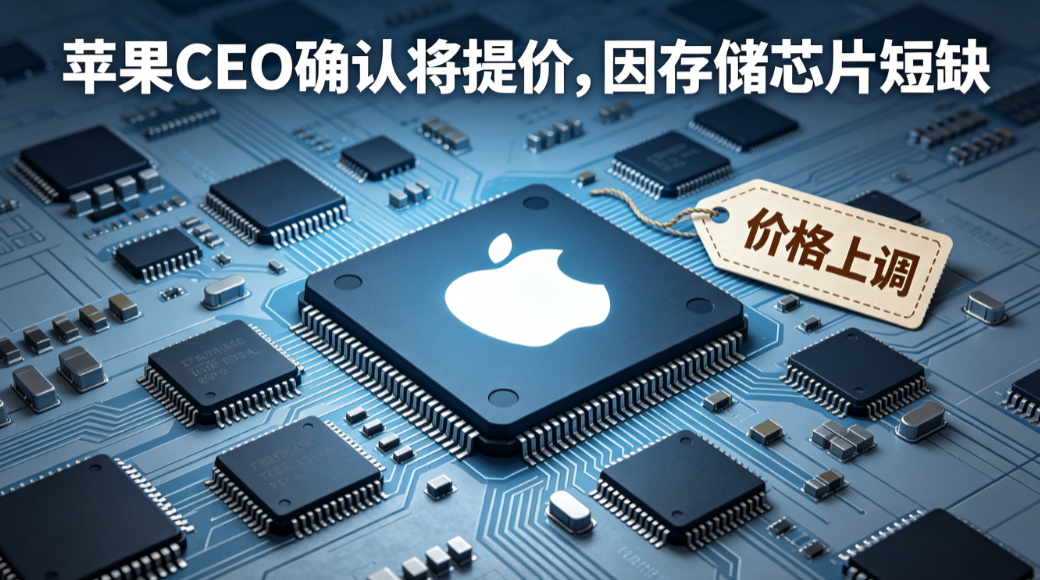
Apple Plans to Raise Product Prices: Cost Pressure from AI Computing Race Transmits to Consumer Endpoints
Keywords
Apple, Price Hikes, Memory Chips, Storage Chips, AI Servers, Supply Chain, iPhone, Tim Cook, DRAM, Industrial Cost
Main Text
Introduction
Against the backdrop of the global tech industry accelerating into the AI era, the chip supply-demand landscape is undergoing profound changes. Memory and storage chips once primarily serving PCs, smartphones, and consumer electronics are now being massively redirected to AI data centers and server markets, becoming key resources in the computing race. This shift in supply focus directly pushes up chip market prices and gradually transmits cost pressure to downstream consumer electronics companies.
Apple CEO Tim Cook recently stated in an interview that the company plans to raise product prices to cope with rising memory and storage chip costs. This statement not only reveals Apple's real considerations in the current supply chain environment but also reflects the common dilemma facing the entire consumer electronics industry: as AI-driven demand continues to swell, the core components relied upon by traditional terminal devices are becoming increasingly scarce, and price increases are no longer short-term fluctuations but may become the new normal.
1. AI Demand Reshapes Chip Market, Consumer Electronics Costs Forced Up
Over the past year, the rapid proliferation of AI technology has driven a global data center construction boom, with massive capital invested in AI training and inference infrastructure. Alongside this, demand for high-bandwidth memory, DRAM, and large-capacity storage chips has surged. For chip manufacturers, the AI server market offers higher profit margins and larger order sizes, naturally attracting more capacity allocation.
This shift in capacity allocation significantly squeezes the consumer electronics industry. Products like smartphones, laptops, tablets, and wearables also rely on memory and storage chips, but in a tightening supply environment, their bargaining power in the supply chain is relatively limited. As a result, prices of key components originally used for consumer endpoints continue to rise, forcing companies to find a new balance between cost control, inventory security, and terminal pricing.
Cook explicitly pointed out in the interview that memory and storage costs have become a key concern for Apple, especially the DRAM market. He mentioned that more supply is being allocated to high-bandwidth memory required by AI servers, meaning "when consumers need devices, memory supply is decreasing." This statement actually highlights an industry reality: the AI boom is not an abstract technological advancement; it is affecting the manufacturing cost of everyday products like phones and computers in very concrete ways.
2. Apple Faces Price Hike Pressure, Tough Choice Between Passing On and Absorbing
As one of the world's most brand-premium consumer electronics companies, Apple has always had strong cost absorption and price adjustment capabilities. But even so, against the backdrop of rising chip costs, Apple cannot fully absorb all the pressure alone. Cook admitted that the company is making every effort to minimize the extent of cost increases passed on to consumers, while striving to avoid negative impacts on user experience and market demand from rapid price increases. However, he also acknowledged that the current situation "is no longer sustainable."
This statement is meaningful. For Apple, price hikes are not simply to increase profits, but more likely a realistic choice to maintain product gross margins and ensure supply chain stability. Especially in an environment where the high-end smartphone market is increasingly competitive and global consumer demand remains weak, any price adjustment could trigger a chain reaction: on one hand affecting sales expectations, on the other hand potentially changing consumers' perception of product value.
Cook did not disclose the specific timing or magnitude of price increases, nor which products would be affected. But from Apple's product structure, the most likely to be affected are the iPhone series and its high-end variants. Especially as next-generation models increasingly demand higher storage capacity, graphics processing power, and AI features, the rise in per-unit material costs has become an undeniable reality. If Apple plans to introduce more AI features and enhance local computing power in the future, its dependence on high-performance memory and storage will only increase, and cost pressure will follow.
3. Supply Chain Tightness Spills Over, Risk of Consumer Goods Price Hikes Expands
Apple is not the only company facing this issue. Groups representing automakers, retailers, electronics companies, and others have previously warned that growing demand for storage chips could lead to significant price increases for US consumer goods and disrupt supply chains. This shows that the impact of chip price increases has transcended a single industry and is spreading to broader consumer areas.
From an industry chain perspective, memory and storage chips, although not as frequently in the public spotlight as advanced process processors, play a foundational role in almost all modern electronic devices. Whether it's smartphone operating efficiency, smart car in-vehicle systems, payment devices at retail terminals, or control modules in home appliances, these key components are essential. Once supply tightens, the price increase effect amplifies along the supply chain, ultimately reflected in terminal prices.
More notably, chip cost increases are not just a periodic price fluctuation; they may also affect companies' medium-to-long-term investment decisions. To secure supply, manufacturers may be forced to lock orders in advance, increase inventory, or even adjust product designs to adapt to the new procurement environment. These changes further raise operating costs and weaken supply chain flexibility.
4. Apple's Response Strategy: Use Cash Reserves to Stabilize Supply
Facing supply shortages and cost increases, Cook stated that Apple is prepared to use its strong cash reserves to increase storage chip supply. He emphasized the company is willing to leverage its balance sheet strength to help address supply shortages and believes the industry needs to expand more capacity.
This reflects Apple's consistent supply chain management approach: not just passively accepting market fluctuations, but proactively laying out, locking resources, and stabilizing supply through capital strength. Over the past years, Apple has built a highly competitive supply chain system through long-term partnerships, prepayments, and strategic procurement. In the current environment of tight memory and storage chips, this strategy will continue to play an important role.
However, Cook also made it clear that Apple has no plans to use its own funds and chip technology to build its own memory and storage chip factories. This means Apple still prefers to maintain an asset-light model, leaving core manufacturing to specialized chip vendors, while itself playing more of a role in demand management, product definition, and supply chain coordination. This choice is consistent with Apple's business logic: rather than entering capital-intensive, long-cycle, and highly technically demanding chip manufacturing, it continues to ensure stable supply through industry collaboration.
5. Management Transition Imminent, Pricing Decisions May Affect Apple's Next Phase
Notably, Cook will hand over the CEO position to John Ternus in September. This statement on price hikes and supply chain pressure can be seen to some extent as Cook's public characterization of Apple's future operating environment during his tenure. Facing a new technology cycle and industrial structural changes, Apple's new management will have to find a new balance between innovation investment, cost control, and market pricing.
Meanwhile, Apple is expected to release its first foldable iPhone in September, along with the iPhone 18 Pro and Pro Max. The convergence of new product launch timing and price adjustment expectations means Apple will enter a critical window period. If chip prices remain high, Apple may be more cautious in pricing new models; if it chooses to pass on some costs to consumers, high-end models may move further into higher price ranges.
From an industry trend perspective, this is not just a strategic choice for one company but reflects the structural changes in the consumer electronics industry in the AI era. In the past, phone makers continuously reduced per-unit costs through scale production and technology iteration. Now, as AI infrastructure intensifies competition for key chip resources, the cost logic of the supply chain is reversing. In the future, whoever can more stably obtain core supply will be more likely to maintain an advantage in fierce competition.
Conclusion
Cook's judgment that "price increases are inevitable" actually reveals an emerging industrial reality: AI is not only reshaping the technology landscape but also restructuring cost structures and market pricing mechanisms. The tilt of memory and storage chip resources toward data centers and AI servers puts unprecedented supply pressure on the consumer electronics industry. Apple's decision to signal price increases in advance is both a response to the market environment and a management of future risks.
It is foreseeable that under the continued expansion of AI computing demand, the cost pressure on consumer electronics will be difficult to ease in the short term. Whether Apple will raise prices, by how much, and when, may still have variables; but what is certain is that the impact of chip supply-demand imbalance has spread from the upstream of the supply chain to ordinary consumers. For the entire industry, what really needs to be considered is not just how to deal with a single price increase, but how to rebuild a more stable and sustainable supply system in the new technology cycle.