SpaceX IPO Ignites Global Retail Frenzy: Why Are Funds Almost Exclusively Flowing Into This One Stock?
Keywords: SpaceX IPO, Retail Fund Inflow, Elon Musk, Tech Giants, Korean Investors, IPO, AI Concept, Market Sentiment, Fund Concentration
Introduction
In recent days, the most watched asset in global capital markets is no longer the traditional "Seven US Tech Giants," but Elon Musk's space exploration company, SpaceX. Since its Nasdaq debut, this new stock combining space, internet, and AI concepts has quickly become the "sole focus" of retail funds. According to Vanda Research, in the first three trading days after SpaceX's IPO, net retail fund inflows exceeded the total retail purchases of all seven US tech giants combined. This phenomenon not only reflects strong market expectations for SpaceX's commercial prospects but also highlights significant changes in current global retail investor behavior.
Against a backdrop of generally cautious market sentiment, SpaceX's frenzy stands out. Funds are not being dispersed across multiple hot tech sectors as before, but highly concentrated in this single stock, creating a rare single-point explosive trading wave. What does this mean? Why can SpaceX drain almost all retail trading funds in such a short time? What market logic and risk signals are hidden behind this?
1. SpaceX IPO Explodes at Launch, Retail Enthusiasm Exceeds Expectations
On June 12 local time, SpaceX officially listed on the Nasdaq. As one of the most anticipated IPOs globally in recent years, this IPO was highly symbolic from the start. For investors, SpaceX is not just a rocket launch company; it is a key fulcrum in Musk's business landscape, spanning space transportation, satellite internet, and AI infrastructure, with vast narrative space and ample imagination.
Market data confirms this strong appeal. SpaceX's IPO attracted over $100 billion in retail subscription, far exceeding its $75 billion financing target. In other words, even before listing, the market had formed extremely crowded expectations for the company, with retail participation enthusiasm exceeding the issuer's initial financing scale.
From a stock price perspective, SpaceX quickly strengthened after listing. By Wednesday's close, its stock price had risen over 42% from the IPO price of $135; during Tuesday's session, its market cap once surpassed Microsoft and Amazon, becoming one of the most talked-about stocks in global capital markets. For retail investors adept at chasing trends and favoring high-growth narratives, such an opening is undoubtedly attractive, further reinforcing the short-term psychological expectation of "buy and make money."
2. High Fund Concentration: SpaceX Absorbs Almost All Retail Attention
In past years, the retail market has long revolved around the "Seven US Tech Giants" in rotational trading. Alphabet, Amazon, Apple, Microsoft, Meta, Nvidia, and Tesla have formed the core asset pool for US retail investors. Especially after the AI wave erupted, Nvidia once became the top retail net buy target, becoming the bellwether for fund chasing.
However, this landscape was quickly rewritten after SpaceX's listing. Vanda Research data shows that in the three trading days after SpaceX's IPO, US retail investors net bought $369.8 million in SpaceX stock; during the same period, retail investors net bought only $88.2 million of Nvidia. In other words, the retail funds absorbed by SpaceX alone far exceeded those for traditional hot targets like Nvidia.
More notably, even when including several core stocks from the Seven Tech Giants and two of the most popular broad-based ETFs — SPY (S&P 500 ETF) and QQQ (Nasdaq 100 ETF) — the total retail buying intensity roughly equaled that of SpaceX. Vanda Research noted in its report that over the past three trading days, the amount of retail buying of SpaceX approximately equaled the combined purchases of Nvidia, Google, Amazon, Microsoft, Meta, QQQ, and SPY. And this statistic does not include Tesla and Apple, both of which were net sold by retail investors during the same period.
This result shows that SpaceX is not just "taking away some hot spots," but has become the absolute center of retail funds to some extent. Such extreme concentration of funds reflects both market trust in Musk's personal brand and SpaceX's growth logic, as well as investors' strong preference for high-certainty narratives and high-elasticity assets.
3. Why SpaceX: Musk's Narrative, Tech Imagination, and Scarcity Premium
SpaceX's ability to quickly ignite market sentiment is no accident. First, Musk himself is one of the most influential entrepreneurs globally. His companies are often not just commercial ventures, but more like "story-making machines" in capital markets. Whether Tesla, X platform, or now SpaceX, what the market buys is not only performance expectations but also the imagination of future technology paths and industrial changes.
Second, SpaceX's sector has strong scarcity. Compared to traditional tech giants, SpaceX does not rely directly on advertising, software subscriptions, or consumer electronics, but enters highly strategic areas like space launches, low-orbit satellite networks, and AI computing infrastructure. These areas have higher barriers, more complex competitive landscapes, and stronger policy hurdles, making them more likely to be granted long-term growth premiums.
Third, in the current global investment environment, retail investors are more sensitive to assets with "high growth, strong stories, and verifiable progress." Against a backdrop of lingering macro uncertainty and increased volatility in traditional sectors, a target with such strong imagination as SpaceX naturally becomes a choice that combines both a safe haven and offensive growth. Especially when its short-term gains are rapid after listing, it amplifies chasing sentiment, forming a typical "emotion-price-fund" positive feedback loop.
4. Korean "Seohak Ants" Join the Fray, Overseas Retailers Also Go Wild
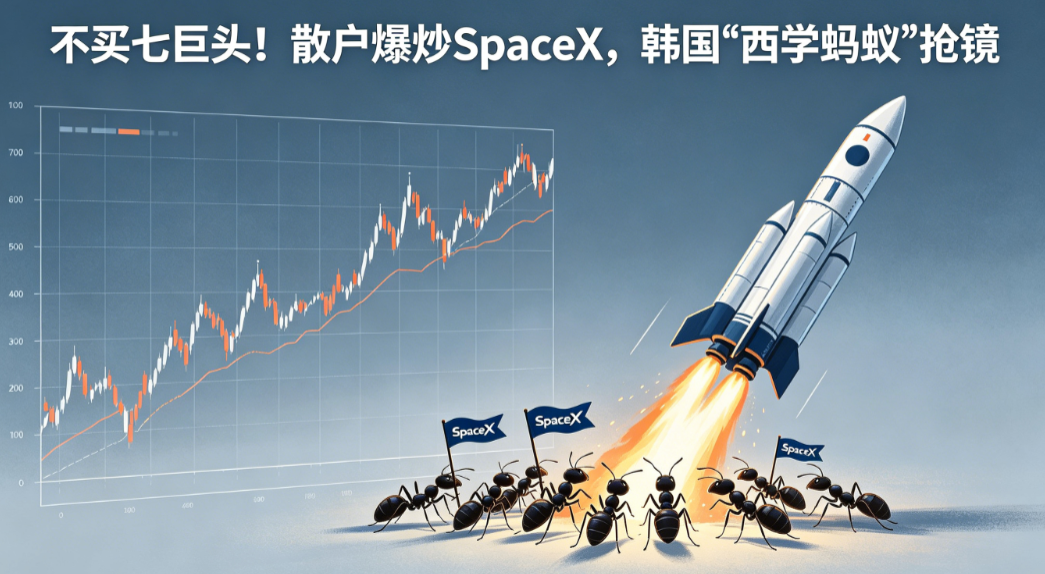
SpaceX's heat is not limited to the US domestic market. The participation of Korean retail investors adds a global dimension to this IPO frenzy. Korean investors, known as "seohak ants," are known for active participation in overseas markets, especially favoring US tech stocks, AI-concept stocks, and high-growth targets.
On SpaceX's first trading day, Korean retail investors showed astonishing buying power. According to Korea Securities Depository data, Korean retail investors' single-day net purchase amount reached $796 million, nearly $800 million, making them one of the most important offshore fund sources for SpaceX. This figure not only made SpaceX the most popular US stock among Korea's 14 million retail investors but also exceeded the cumulative net purchase amount of any other US stock over the past three months.
In fact, Korean investors' interest in SpaceX did not suddenly appear after the listing. Earlier, they had already positioned through related theme ETFs. Data shows that over the past month, Korean investors net bought $316.54 million worth of TEMA Space Innovators ETF, which is closely related to the SpaceX theme. This indicates that Korean retailers are not simply chasing short-term hot spots, but have configured their portfolios around the long-term narrative of space technology and AI integration.
From this perspective, SpaceX's global popularity is not just a simple IPO phenomenon, but more like a capital race for the "future tech entrance." US domestic retail and overseas retail resonate on the same target, further amplifying market volatility.
5. Hidden Concerns Under the Frenzy: Concentrated Trading Does Not Equal Broad Optimism
Despite the huge demand for SpaceX after listing, this frenzy has not effectively driven a broad rally across the US stock market. Vanda Research pointed out that even with the incremental funds from SpaceX's listing, last week's weekly net retail purchase amount for individual US stocks hit a new low since March 2020. This shows that retail investors remain cautious about the overall market, only placing concentrated bets on a few highly attractive targets.
This also means that the SpaceX rally is more like an "island of frenzy," rather than a true broad recovery in risk appetite. In other words, funds have not flowed back into broad tech sectors or high-beta assets, but are extremely concentrated in a single target. Vanda Research explicitly stated that the SpaceX rally has not led to broad gains, and retail fund inflows into other AI-related stocks are far below market expectations; there is almost no spillover effect.
This structure is worth watching. Because when the market is overly dependent on a single narrative or a single stock, once the stock price fluctuates, sentiment retracement can also be very fast. On Wednesday, under the influence of market weakness and profit-taking, SpaceX surged then fell back, ultimately closing down 4.95% at $191.82, recording its first negative candle since listing. This shows that although fund enthusiasm is high, short-term positions have begun to diverge, and chasing at highs faces certain pressure.
6. Conclusion: SpaceX Frenzy Is a Vote on the Future and a Test of Sentiment and Valuation
In the short term, SpaceX is undoubtedly one of the most talked-about stocks in global capital markets. It not only carries Musk's personal brand but also aggregates the imagination of multiple high-growth sectors such as space exploration, low-orbit satellites, and AI infrastructure. As a result, it quickly attracted retail funds after listing and completed a "traffic interception" of traditional hot tech stocks in a short time.
But from a longer-term perspective, this frenzy also reveals an important reality: current retail funds are not returning to broad and balanced risk appetite, but are highly concentrated on a very small number of super-narrative assets. This phenomenon can boost stock prices and amplify attention, but it also easily brings increased volatility and risk of valuation overstretch.
For investors, SpaceX's listing is not just a trading opportunity, but also a vote on the future technology path. However, the higher the voting enthusiasm, the stricter the test of fundamentals, valuation, and fulfillment capability. Frenzy can ignite prices, but whether it can support long-term value ultimately depends on performance, technology, and commercialization ability itself.