EU and Apple's Game Over Siri AI Upgrade: Privacy, Platform Responsibility, and Regulatory Boundaries
Introduction: A Head-On Clash Between Innovation and Compliance
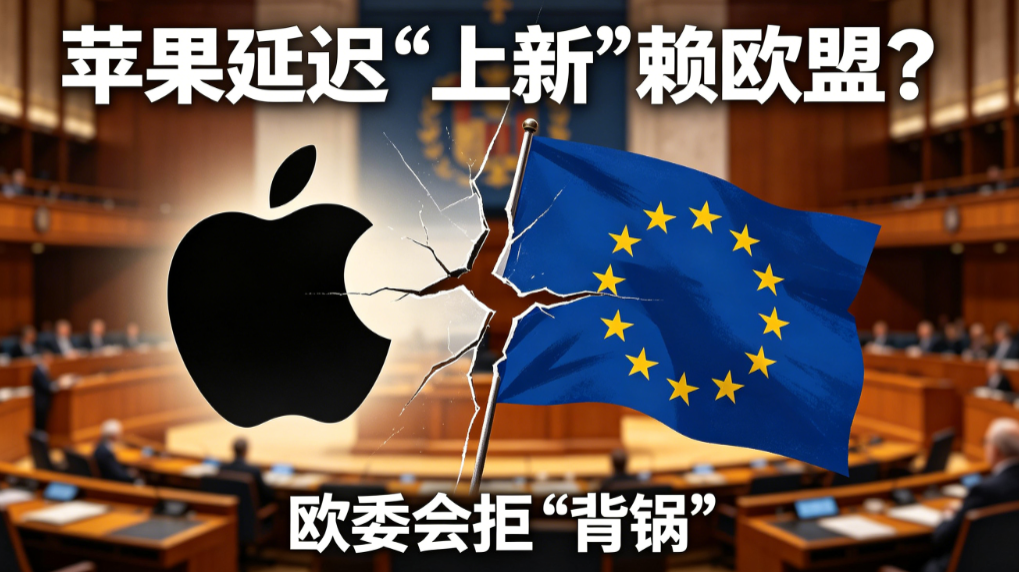
Recently, the European Commission publicly accused Apple of blaming the delay in launching the AI-upgraded voice assistant Siri in the EU on the Digital Markets Act, arguing that the claim is unfounded and the decision was made unilaterally by Apple, unrelated to EU regulations. This statement quickly escalated a technical dispute over product launch timelines into an institutional discussion about platform responsibility, user privacy, and market rules.
Apple insists that the EU regulatory framework imposes overly high openness requirements on tech companies, potentially forcing it to share critical access with competitors, thereby increasing the risk of user data being "directly read." The two sides appear to be arguing over the rollout pace of an AI feature, but in essence, they are competing for the right to interpret digital-era rules: Should companies prioritize innovation efficiency, or must privacy and security be placed before commercial expansion?
Main Text: Collision of Regulatory Logic and Corporate Demands
Apple released the AI-upgraded Siri at its 2026 Worldwide Developers Conference, marking a significant step in intelligent interaction. However, users in the EU cannot yet use this feature, not just due to technical deployment timing, but also reflecting Apple's deep concerns about the Digital Markets Act. The law emphasizes that large tech platforms should provide more open access conditions to competitors to break closed ecosystems and promote market competition. But in Apple's view, such "openness" may weaken its control over user data, especially as AI systems require processing large amounts of personal information, making the risk non-negligible.
Apple's concerns are not entirely unfounded. The core capability of an AI assistant relies on comprehensive processing of user behavior, preferences, communications, and device permissions. If third-party services can access the system without strict restrictions, it could indeed lead to data misuse, permission overreach, and even privacy leaks. From a corporate perspective, Apple has always used "privacy protection" as its core brand competitiveness, and its cautious approach to launching Siri AI in the EU aligns with its business strategy and risk control logic.
But the EU's response is equally noteworthy. Spokesperson Thomas Regnier clearly stated that Apple has not genuinely sought a technical solution that meets EU basic privacy and security standards, but instead hoped for an 18-month exemption, which the EU rejected. The EU's stance shows that its regulatory approach is not to reject innovation, but to require innovation to operate within the legal framework and cannot avoid compliance obligations under the pretext of technical complexity. In other words, the EU is not preventing Siri AI from entering the market, but requiring Apple to prove how it ensures that user data is not misused while allowing open access.
Platform Responsibility: Openness Does Not Mean Loss of Control
The key to this dispute lies in understanding the relationship between "openness" and "security." Large platforms hold vast amounts of user data and system entry points in the modern digital economy, making them both innovation carriers and de facto participants in rule-making. If platforms maintain highly closed ecosystems for a long time, it may enhance product consistency and security, but it also easily creates market barriers and inhibits competition. The EU promotes the Digital Markets Act precisely to correct this structural imbalance.
However, openness does not mean unlimited data or permission sharing. For platform governance in the AI era, the regulatory focus should not just be on "whether to open," but more on "how to set boundaries while opening." If third-party access mechanisms lack tiered authorization, the principle of minimum necessity, and continuous auditing, openness itself could become a source of security vulnerabilities. Therefore, what Apple and the EU really need is not "whether to open," but "which way to open is legal, compliant, and sustainable."
Conclusion: Tech Competition Will Ultimately Return to Rule Competition
The delayed launch of Siri AI in the EU appears to be an adjustment in product release pace, but it actually reflects deep contradictions in global digital governance: platform companies want to maintain control in innovation, while regulators demand that technological progress must be subject to public rules. For Apple, continuing to use "privacy protection" as a reason for not launching may maintain its brand stance, but it could also be seen as a passive response to regulatory requirements. For the EU, adhering to rule boundaries helps maintain market fairness and user rights, but it also needs to avoid excessively high compliance costs that could stifle genuinely valuable technological innovation.
It is foreseeable that as AI applications continue to penetrate operating systems, terminal devices, and personal services, similar disputes will continue to emerge. The future key is not about one side completely winning, but whether a governance mechanism can be established that balances innovation efficiency, market competition, and data security. Only when tech companies and regulators both recognize that rules are not barriers to innovation but prerequisites for sustainable innovation can the digital economy truly mature.