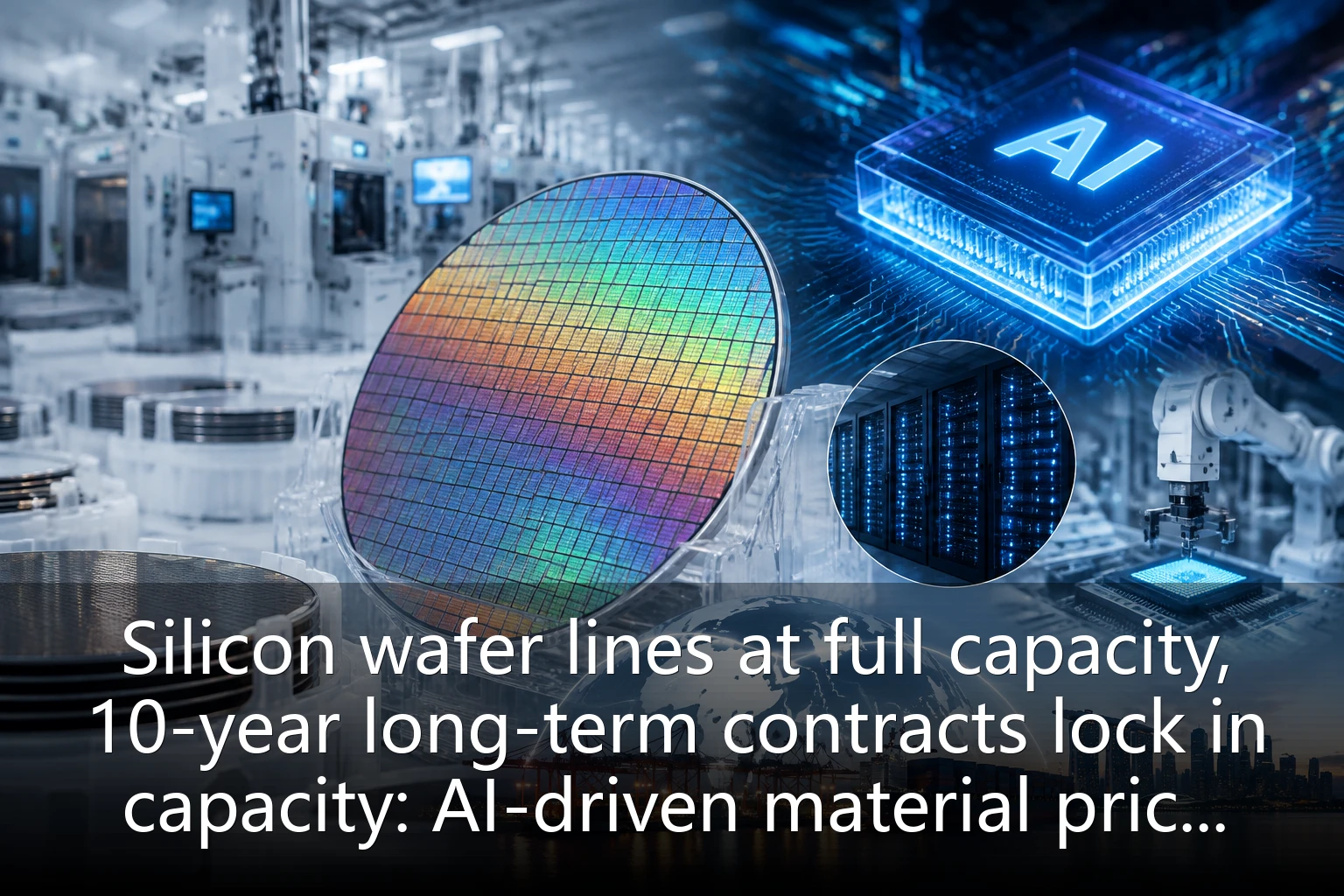
Entering August 2026, the global semiconductor upstream materials market has reached a landmark inflection point: silicon wafer supply has swung from "oversupply" to "full capacity." According to Korean media The Elec, GlobalWafers said in its Q2 earnings call that its 12-inch, 8-inch, and 6-inch production lines are all nearly at full capacity, with some advanced 12-inch products facing supply constraints, mainly due to surging demand for AI chips, HBM (high-bandwidth memory), and advanced packaging, which is rapidly consuming upstream material capacity. This signal is seen by the industry as a direct footnote to the full-scale launch of a new round of silicon wafer price increases.
Giants in Tune: Supply-Demand Inflection Point Confirmed from Multiple Sides
GlobalWafers' capacity statement is not an isolated case but a collective consensus among global silicon wafer leaders. Shin-Etsu Chemical saw double-digit year-on-year and quarter-on-quarter growth in 12-inch shipments in Q2; SUMCO assessed in its earnings call that downstream customers' inventory adjustments are nearing completion, making the demand recovery more sustainable; SK Siltron, although steadily releasing new capacity, still saw order growth outpacing production ramp-up. The fact that multiple giants issued similar signals in the same time window indicates a substantive reversal in the supply-demand landscape of the silicon wafer industry.
From a longer-term perspective, this inflection point has been brewing for some time. From 2023 to 2025, the silicon wafer industry experienced a prolonged period of inventory destocking and low prices, with leading manufacturers adopting conservative capital expenditures and limited new capacity. Since 2026, however, AI computing power investments have grown explosively, and the expansion of advanced processes and memory production has accelerated simultaneously, rapidly driving up silicon wafer demand while supply failed to keep pace, thus creating a supply-demand gap.
Price Hikes Land: 5%-8% for Standard, 18%-22% for High-End Wafers
The most direct manifestation of tighter supply-demand is pricing. According to industry statistics, in 2026 the three international giants—Shin-Etsu Chemical, SUMCO, and GlobalWafers—have completed two rounds of price adjustments: standard 12-inch wafers have accumulated increases of approximately 5% to 8%, while high-end specialty wafers tailored for AI and HPC computing scenarios have risen by as much as 18% to 22%, showing a significant shortage of high-end products. Domestic manufacturers have followed suit, with Lion Micro raising wafer prices by 10% to 15% effective July 1.
CITIC Securities, in its latest research report, concluded that Q2 2026 is the official starting point of the wafer price hike cycle, and that wafer prices at home and abroad may continue to rise in the second half of the year, with the industry expected to remain in a state of supply shortage for the next two years, and the price hike cycle likely to last two to three years. BOC International also noted that since 2026, a price hike wave has swept global semiconductor materials, expanding from point to surface, spreading from key chemical raw materials to the entire manufacturing chain. Some overseas leaders are slow to expand production or constrained by key raw materials, opening a window for domestic excellent material companies to accelerate substitution.
Demand Breakdown: HBM Consumes 3x, AI Servers Use 3.8x Silicon
The fundamental driver of this round of silicon wafer price increases comes from the structural amplification effect of AI demand. Industry research shows that HBM, due to wafer stacking, yield constraints, and larger chip sizes, consumes about three times the silicon wafers of traditional DRAM at the same capacity; an AI server uses about 3.8 times the silicon of a regular server. The widespread transition of 3D NAND to dual-wafer bonding technology has also significantly increased wafer usage per unit of storage capacity.
Because of this "multiplier lever," high-resistance heavily doped wafers used with HBM have been almost bought out. Currently, only Shin-Etsu Chemical and SUMCO can stably supply them globally, with prices directly pushed up 10% to 25%. SUMCO expects that AI demand for advanced-process 12-inch wafers will reach 1 million wafers per month in 2026, accounting for more than 10% of global demand. Shin-Etsu Chemical and SUMCO predict that AI-related demand will quickly exceed 20% of total 12-inch wafer shipments in the next three years. Currently, AI demand accounts for less than 10% of total 12-inch wafer shipments, implying vast room for growth.
Long-Term Agreement Era: 10-Year Deals and Prepayments Reshape the Game
Supply tightness is reshaping the business model of the silicon wafer industry. The most typical case is the deep binding between GlobalWafers and Micron: Micron provides $500 million in strategic financing to GlobalWafers to support the development and manufacturing capabilities of its 300mm silicon wafer fab, and the two have signed a 10-year supply agreement to ensure Micron obtains critical silicon wafer capacity to support its long-term manufacturing plans. This combination of "capital + long-term agreement" is rare in the history of the silicon wafer industry, reflecting that memory giants' anxiety over upstream material supply is translating into concrete actions to lock in capacity.
Meanwhile, prices in the non-LTA market have begun to rise and are expected to continue higher in the second half of the year. GlobalWafers said it is negotiating with customers to include price adjustment mechanisms in new contracts; Siltronic also stressed the need for "broad and meaningful price increases" to support reinvestment. This means the past situation where silicon wafer manufacturers were locked into long-term prices and lacked pricing flexibility is changing, and pricing power in the industry chain is beginning to shift toward the material segment.
Gap Outlook: Demand to Double in H2 2027
What deserves more attention is that the supply-demand gap is hard to close in the short term. The industry expects that as new fabs from memory giants such as Samsung, SK Hynix, and Micron come online one after another, global silicon wafer demand will double from current levels in the second half of 2027, potentially worsening the supply shortage. On one hand, memory expansion is the absolute main consumer of silicon wafers; on the other, AI logic chips' migration to advanced processes creates rigid demand for high-spec large-diameter wafers. The silicon wafer industry is jumping directly from a "long cycle trough" to a "super boom" phase, with order visibility significantly higher than downstream memory manufacturing.
Transmission to Singapore: Wafer Foundry and Southeast Asian Supply Chain Under Pressure
The impact of silicon wafer price increases is not limited to the material segment; it is transmitted step by step down the industry chain to wafer foundry, packaging and testing, and even end manufacturing. For Singapore, as a semiconductor manufacturing hub in Southeast Asia, the direct material costs of local wafer fabs (such as GlobalFoundries Singapore fab, SSMC, etc.) will rise accordingly. Under cost pressure, foundries' willingness to raise prices has clearly strengthened: VIS recently stated that foundry capacity remains fully loaded and predicted that chip foundry contract prices in 2027 will rise no less than in 2026, sustaining the upward trend in industry foundry prices. UMC has also issued a price hike notice, announcing that it will adjust wafer foundry prices based on product mix in the second half of 2026, with the market generally expecting 5% to 20% upside for 8-inch foundry quotes.
Looking at macro data, Singapore's manufacturing PMI rose to 51.4 in July, remaining in expansion territory for the 12th consecutive month, while the electronics PMI hit a new high since 2018, with AI-related demand continuously driving electronics order growth. Although the price increases of upstream materials such as silicon wafers will squeeze manufacturing profits in the short term, they also confirm the real strength of downstream demand. For Singapore, a node deeply embedded in the global semiconductor supply chain, the material boom is both a cost challenge and a reflection of the overall improvement in the industry chain's bargaining power.
Conclusion: Investment Implications of the Material Price Hike Cycle
In summary, this round of silicon wafer price increases is the result of three factors resonating: surging AI demand, rigid supply constraints, and the reshaping of long-term agreement models, and the cycle is far from over. For practitioners and investors, three points deserve attention: first, the scarcity premium for high-end specialty wafers will continue to expand, and the earnings elasticity of leading material manufacturers should be valued; second, the long-term agreement and prepayment model will change the earnings volatility characteristics of the material segment, significantly enhancing revenue stability; third, the transmission pace of price hikes to foundry and packaging/testing segments will determine the profit redistribution landscape across downstream segments. Of course, one should also be wary of possible expectation corrections if AI capital expenditures slow down temporarily. In the semiconductor boom cycle, the material segment's trend often "precedes manufacturing and outlasts manufacturing." This round of silicon wafer market may have just entered its main upward phase.